

Key Takeaways
- Wavelength decides everything: diode lasers emit 455±5nm blue light, CO2 lasers emit 10.6μm far-infrared — a 20x+ difference, so material absorption is completely different
- Thick wood cutting favors the diode: the K70 Max is rated to cut 28mm paulownia in a single pass; the Master (CO2) tops out at 13mm wood
- Acrylic splits by transparency: opaque acrylic — diode rated 25mm; transparent acrylic — CO2 only, Master rated 18mm in one pass
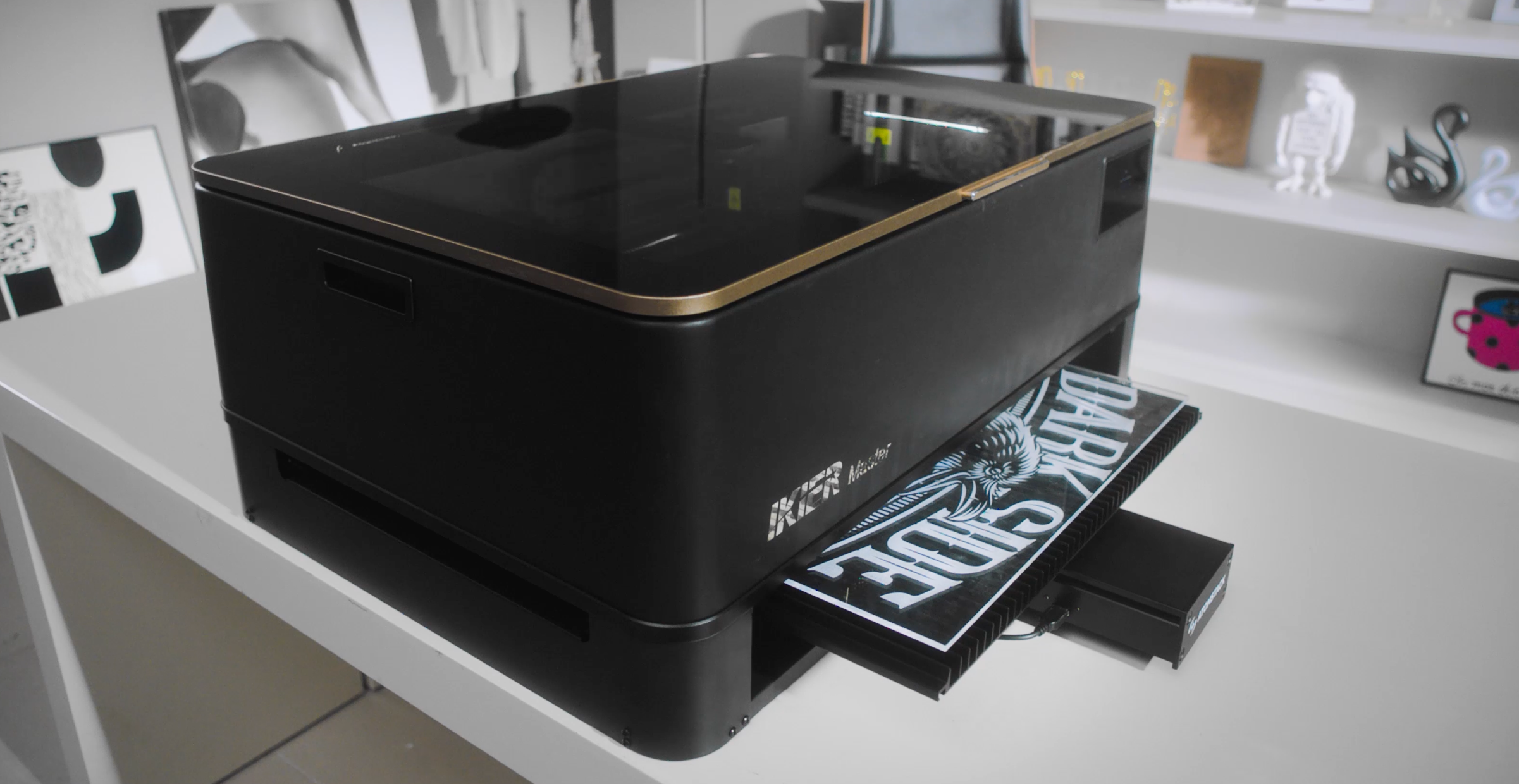
- Working area vs portability is the hidden divide: the K70 Max's 850×800mm bed swallows full sheets; the Master's 28kg ultra-light body is a rare compact form in the 50W CO2 class
- Price anchors: K70 Max from $1,399 (MSRP $1,499), Master from $2,149 (MSRP $2,399) — a gap of about $750
What Is the Difference Between a Diode Laser and a CO2 Laser?
A diode laser uses a semiconductor as its gain medium — the iKier K70 Max outputs 455±5nm blue light. A CO2 laser uses carbon dioxide gas as its gain medium and outputs 10.6μm far-infrared light. The wavelengths differ by more than 20x, so material absorption differs completely:
- Metal: strongly reflects 10.6μm — CO2 cannot process it without a coating; absorbs 455nm relatively better, but even the diode is limited to surface marking on materials in its recommended list — neither route is a mainstay metal solution (that is 1064nm fiber/IR)
- Transparent acrylic: nearly "invisible" to 455nm (no absorption), absorbs 10.6μm fully → CO2 only
So the right question is not "which laser is stronger" — it is: what is your primary material?
Metal, Acrylic, Wood: The Head-to-Head
Benchmarked against our two machines' rated data (K70 Max: 70W cutting / 35W engraving dual-mode, 70–77W actual output; Master: 50W CO2, optional 1.6W IR module):
|
Material |
Diode (K70 Max rated) |
CO2 (Master rated) |
Winner |
|
Wood cutting |
28mm paulownia in one pass |
Max 13mm |
Thick cuts: diode |
|
Opaque acrylic |
25mm in one pass |
Acrylic ceiling 18mm |
Diode |
|
Transparent acrylic |
Cannot process (455nm passes through, no absorption) |
18mm in one pass; physical-probe auto focus built for transparent material |
CO2 |
|
Metal surface marking |
Recommended-list materials only: 304 mirror stainless steel, oxidized aluminum, plated/painted metal (surface level) |
CO2 source not applicable to metal; optional 1.6W IR module marks stainless steel, gold, silver, platinum, titanium |
Relative edge: diode; mainstay solution: 1064nm fiber/IR |
|
Glass/ceramic |
Surface engraving (recommended list includes glass, ceramic, slate; glass usually needs a dark coating to assist absorption) |
Surface engraving: rapid surface heating forms micro-fracture frosting — not cutting (list includes glass, rock & ceramics) |
Surface engraving: CO2 is more direct; glass cutting: neither |
|
Leather |
Recommended engraving list includes leather |
Compatibility list includes leather |
Both work |
A counterintuitive verdict: neither diode nor CO2 wins the metal round — the diode only has a relative edge; the real answer is 1064nm fiber/IR.
- Common misconception: assuming enough power (70W diode or 50W CO2) can handle any metal
- CO2: 10.6μm is strongly reflected by metal — the CO2 source itself cannot process metal
- Diode: 455nm absorbs relatively better, but only for surface marking on recommended-list materials — 304 mirror stainless steel, oxidized aluminum, plated/painted metal (marking, not cutting); highly reflective bare aluminum, copper, and precious metals are off the table
- The real answer for a metal business: the 1064nm route — our K1 Pro 1064nm 20W fiber laser (rated to cut 0.2mm aluminum cards), or the Master with the 1.6W IR module (sold separately, covers gold, silver, platinum, titanium); if metal is your main business, go straight to fiber
- The diode's rightful role: wood and opaque acrylic as the main business, picking up light-duty stainless steel name-tag marking jobs from the recommended list on the side; transparent acrylic is outside diode capability — see the table above
Boundaries beyond the wattage number:
- Cut-through ability = true optical power + focusing + air assist working together — never judge by the rated watts alone
- Third-party corroboration: hobbylasercutters.com measured 70–77W optical output on our same-architecture K1 Pro Max — at or slightly above spec (same-architecture evidence, not a K70 Max unit test)
Cost, Working Area, and Maintenance: Two Ownership Structures
|
Item |
K70 Max (diode) |
Master (50W CO2) |
|
Price (MSRP) |
$1,499, now from $1,399 |
$2,399, now from $2,149 (pre-sale) |
|
Light source & upkeep |
Semiconductor module, air-cooled, fixed alignment-free optical path |
CO2 glass tube is a consumable; FlyLock optical path stabilization — 99.7% stability, no realignment after transport |
|
Working area |
850×800mm |
500×300mm, expandable to 500×800mm with conveyor |
|
Max speed |
600mm/s |
800mm/s |
|
Body |
All-metal large frame + dual-axis linear rails, open (optional E3 enclosure) |
Fully enclosed Class 1, 28kg ultra-light (862×584×255mm) |
|
Offline operation |
4.3-inch display, USB/Wi-Fi transfer |
5-inch touchscreen + 16MP camera, plug-and-play USB |
|
Safety |
Child lock, flame sensor, tilt shutdown |
Flame detection, lid-open pause, child lock |
Reading the cost table:
- The ~$750 gap buys the Master: transparent-material capability, fully enclosed safety, and portability
- Where the K70 Max spends its budget: the 850×800mm bed + thick-material punch-through
- Maintenance: FlyLock removes traditional CO2 mirror-alignment pain; the glass tube's consumable nature remains a long-term cost the diode route never has
When Should You Choose a Diode Laser (K70 Max)?
If your primary materials are wood and opaque acrylic (with metal limited to light recommended-list marking), take the diode route. Etsy trend data (weekly snapshots, May–June 2026) shows a real, currently selling case for each of these two materials:
Case 1: Wood — Father's Day handprint signs
- Listing: Hands Down Best Dad Ever Sign (custom handprint wood sign), from $11.95
- Market data: 298.6k cumulative shop sales (9-year shop), 8 buyers in the last 24 hours
- Business logic: holiday gifting is evergreen custom demand; outline cutting + handprint/name engraving on a reusable template — built for batching
- Hard spec match: 70W/35W dual-mode one-click switching — no choosing between cutting and engraving
Case 2: Opaque acrylic — business logo signs (a new-shop growth sample)
- Listing: Custom Business Logo Sign (laser-cut acrylic), $15
- Market data: 258 sales in the shop's first 5 months, currently in 20+ carts
- Business logic: B2B small-merchant signage is a repeat-order category a brand-new shop can enter — 5-month traction says the entry barrier is machine capability, not shop tenure
- Hard spec match: 25mm rated opaque acrylic ceiling, 0.01mm engraving precision
What the two cases share: two materials, three product lines, all inside the diode's capability list. That maps to our K70 Max: one-click auto focus + red-light positioning, auto-sinking cutting for cleaner edges, 0–60 L/min stepless air assist, a 4.3-inch display for offline jobs, and full LightBurn/LaserGRBL compatibility. Machine only from $1,399 (MSRP $1,499); bundles with enclosure, purifier, and rotary run $1,499–$2,399.
An honest boundary: the numbers above are Etsy demand-side data (weekly trend snapshots; shop sales are cumulative, not per-listing). They prove these product categories sell — whether you profit still depends on order flow, pricing, and capacity. This article makes no income promises.
When Should You Choose a CO2 Laser (Master)?
If your main products live on transparent acrylic and glass surface engraving, go straight to CO2. Also from the Etsy trend data:
- Transparent acrylic: Wedding Post Card Box (acrylic card box), from $32.99, 47.4k cumulative shop sales (6-year shop), 20+ views in the last 24 hours
- Glass: Laser Engraved Pint Glasses with Gold Rim, 4pc, from $39.95, 203.6k cumulative shop sales (11-year shop)
Our answer on this route is the Master 50W CO2 (from $2,149, MSRP $2,399): 18mm transparent acrylic in one pass, 800mm/s, 16MP camera batch positioning; a 28kg ultra-light compact body (comparable machines run 41–45kg) makes it the most portable form in the 50W CO2 class — markets, pop-ups, and on-site customization all load and move easier. Add the 1.6W IR module to cover stainless steel, gold, silver, platinum, titanium, and ABS/PC plastic marking.
5 Steps to Choose: Match the Machine to Your Material List
- List your primary products and materials for the next 12 months (use platform best-seller data, not gut feel)
- Transparent acrylic or glass surface engraving on the list → you need a CO2; none → diode first
- Check cutting thickness: wood jobs over 13mm are beyond the CO2 route — you need a 70W-class diode
- Check working area and setting: full-sheet work wants 850×800mm; mobile business wants the 28kg form
- Count cost of ownership: the glass tube consumable goes in the CO2 column; the diode is air-cooled and alignment-free
FAQ
Q1: Can a diode laser cut transparent acrylic?
A: No. 455nm blue light passes straight through transparent acrylic — the energy is never absorbed. Transparent acrylic requires a CO2 machine (Master rated 18mm in one pass, with physical-probe auto focus). Opaque acrylic is the reverse: a diode cuts 25mm (K70 Max rated), beyond the CO2's 18mm ceiling.
Q2: Can a CO2 laser engrave metal?
A: The CO2 source itself cannot engrave metal (10.6μm is strongly reflected). A diode can surface-mark recommended-list materials only (304 mirror stainless steel, oxidized aluminum, plated/painted metal) — marking, not cutting; bare aluminum, copper, and precious metals are off the table. If metal is your main business, skip both: choose our K1 Pro 1064nm fiber (rated to cut 0.2mm aluminum cards), or add the Master's 1.6W IR module (covers gold, silver, platinum, titanium, and plastic marking).
Q3: What setup does it take to cut 28mm thick wood?
A: Benchmark on the K70 Max rating: 70W mode (70–77W actual output) + auto-sinking cutting + 0–60 L/min air assist cuts 28mm paulownia in one pass. Paulownia is low-density — lower your expectations for hardwood at the same thickness; the Master (CO2) tops out at 13mm wood.
Q4: Which has lower maintenance costs, diode or CO2?
A: Diode. Air-cooled semiconductor module, fixed alignment-free optical path, no consumable light source. A CO2 glass tube is a consumable requiring replacement at end of life. The Master's FlyLock system removes post-transport realignment (99.7% stability), but the tube's long-term cost remains.
Q5: What is the price gap between the K70 Max and the Master, and which is the better buy?
A: MSRP gap is $900 (K70 Max $1,499 vs Master $2,399); current selling gap is about $750 (from $1,399 and $2,149 respectively — see product pages for live pricing). The gap buys transparent acrylic/glass capability and a fully enclosed body — worth it if your material list uses it; if not, the K70 Max is the better buy.
Q6: Can a laser cut or engrave glass?
A: Cutting — no. Neither desktop diode nor CO2 machines can cut glass. Engraving splits by route: CO2 (glass is in the Master's material list) engraves glass surfaces directly — rapid surface heating creates micro-fractures that form a white frosted finish; this is surface treatment, not cutting through. The diode (glass is in the K70 Max recommended list) barely absorbs into glass at 455nm — the field practice is coating the surface with a dark layer first for even marking. Safety note: some colored/art glass contains cadmium and other heavy metals that laser heating can release — not recommended even with fume extraction; verify your material first.
Q7: Which should a beginner buy first?
A: Decide by material, not experience level. Starting with wood goods, small metal items, and opaque acrylic — choose the K70 Max (from $1,399). Building on transparent acrylic LED signs, glassware engraving, or a business that travels with the machine — go straight to the Master, no detours.
Conclusion: If You Remember Only 3 Things
- Diode vs CO2 is not a strength contest — it's a wavelength division of labor: 28mm thick wood and 25mm opaque acrylic go to the diode; transparent acrylic and glass surface engraving go to CO2 (neither cuts glass); metal marking belongs to 1064nm fiber/IR, with the diode moonlighting on light recommended-list jobs.
- Count the full ownership cycle: the CO2 glass tube is a consumable while the diode is air-cooled and alignment-free; the Master's FlyLock solves the alignment pain but not the consumable nature.
- Match your primary material: wood/metal-light/opaque acrylic → K70 Max (from $1,399); transparent acrylic/glass/mobile business → Master 50W CO2 (from $2,149).

